Best Golf Simulator Nets (2026)
The best golf simulator and practice nets for 2026: Net Return, Spornia, Rukket Haack, GoSports and more, with safety, noise, durability and space guidance for tight rooms.
The best golf net for most home practice is the Net Return Pro Series, a heavy-duty net with an automatic ball return that survives years of daily driver work. If you want a self-contained mini range that folds away, the Spornia SPG-7 is the standout, and the GoSports 10'x7' covers the basics on a budget. A net is the simplest way to practice or run a launch monitor in a tight space, a far cheaper alternative to a full screen and enclosure. Here are six real picks plus how to choose for safety, noise, and space.
Best Golf Simulator Nets for 2026

Net Return Net Return Pro Series Golf Net (8'x7'6")
Heavy-duty multi-sport net with patented automatic ball return and tool-free five-minute assembly, the durability benchmark for daily indoor or garage practice.
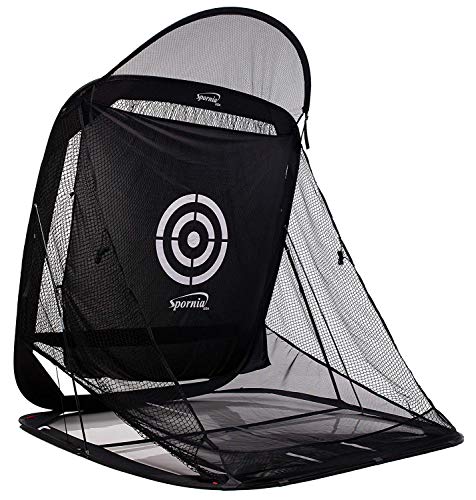
Spornia Spornia SPG-7 Golf Practice Net
Pop-up net with an automatic ball return, angled target sheet, side barriers and a roof, giving you a contained mini range that folds down for storage.
Rukket Sports Rukket Haack Golf Net (10'x7')
Carbon-frame portable net with a heavy backstop and side barrier panels, designed by a college coach for fast setup and serious driver speeds.

GoSports GoSports 10'x7' Golf Practice Net
Large entry-level net with a steel frame and multi-layer backstop sized for a full driver, the most popular budget pick for backyards and garages.

Gagalileo Gagalileo Golf Hitting Net (10'x7')
Backyard backstop with a silent velvet target and noise-reducing baffle layers, built for outdoor driver practice where neighbor noise is a concern.
SwingTurf SwingTurf Simulator Net
A simulator-focused barrier net option; configurations and sizing vary by listing, so confirm dimensions and frame type before buying for a dedicated bay.
A hitting net is the most space-efficient and budget-friendly entry into indoor golf. Pair one with a launch monitor and a good mat and you have a working simulator front end: you get full ball and club data, you can practice any time, and you can fit it into a garage bay or basement corner that would never hold a full enclosure. The tradeoff is that you do not see projected ball flight on a screen, but for grooving a swing and tracking numbers, a net does the job for a fraction of the cost.
Quick comparison
| Net | Size | Ball return? | Best for | Price |
|---|---|---|---|---|
| Net Return Pro Series | 8' x 7'6" | Yes, automatic | Durability, daily use | $795.00 |
| Spornia SPG-7 | Pop-up, with roof | Yes, automatic | Contained mini range | $349.99 |
| Rukket Haack | 10' x 7' | No | Portable, fast setup | Check price |
| GoSports 10'x7' | 10' x 7' | No | Best budget full-size | $89.99 |
| Gagalileo 10'x7' | 10' x 7' | No | Quieter backyard use | $86.99 |
| SwingTurf | Varies | Varies | Dedicated sim bays | Check price |
Amazon pricing changes often, so treat these as a snapshot. Before buying, confirm the net fits your ceiling and swing with our golf sim room size calculator, and if you are weighing the whole project, the golf sim cost calculator shows how a net keeps the total down versus a full enclosure.
Net Return Pro Series (Best Overall)
The Net Return Pro Series is the net serious home golfers buy when they plan to hit thousands of balls. The multi-layer netting is built for driver speeds, the patented design feeds the ball back to your feet automatically so you are not constantly bending down, and the frame assembles in about five minutes with no tools. It is also multi-sport, so it doubles for baseball or lacrosse. It costs more than any pop-up net, but the durability and the automatic return are why owners rate it as a buy-once piece of gear.
Spornia SPG-7 (Best Ball Return)
The Spornia SPG-7 wraps a lot of features into a pop-up frame: an automatic ball return, an angled target sheet that shows your strike pattern, side barriers to catch mishits, and a roof so high shots stay contained. The result feels like a small enclosed range rather than a flat net, and it folds down for storage between sessions. For golfers who want shot containment and the convenience of a return without the Net Return price, it is the value pick in the auto-return category.
Rukket Haack (Best Portable)
The Rukket Haack net, developed with college coach Tobias Haack, is built for golfers who want a sturdy net they can move. It uses a carbon-fiber frame with a heavy-duty backstop and side barrier panels to catch errant shots, and it sets up quickly for garage, backyard, or travel use. There is no automatic ball return, so you collect your own balls, but the build is rated for full driver speed and the portability is a real advantage for renters or anyone short on permanent space. Configurations and current pricing vary, so check the listing.
GoSports 10'x7' (Best Value)
The GoSports 10'x7' is the default budget net for good reason: it is large enough to swallow a full driver, uses a steel frame with a multi-layer backstop, and costs a fraction of the premium options. There is no ball return and the netting is lighter duty than a Net Return, so it suits moderate practice rather than all-day pounding. For a first net, for occasional sessions, or for a backyard range you will not use daily, it delivers the most coverage per dollar.
Gagalileo 10'x7' (Best for Backyards)
The Gagalileo net targets outdoor practice where noise matters. Its silent velvet target and noise-reducing baffle layers soften the bang of each strike, which keeps the peace with neighbors better than a taut standard net. The 10x7 size handles a full swing, and the heavier backstop construction holds up to driver speeds outdoors. If your practice happens in a backyard near other homes, the quieter design is a meaningful upgrade over a basic budget net.
SwingTurf (Best for Sim Bays)
SwingTurf is a simulator-focused brand whose barrier netting is aimed at dedicated bays rather than casual backyard use. Because configurations and sizing vary by listing, treat this as a search-and-verify pick: confirm the exact dimensions, frame type, and whether it suits your bay before ordering. If you are building a fixed simulator space and want netting tuned for that environment, it is worth comparing against a full enclosure setup.
Safety, noise, durability, and space
Four things separate a good net experience from a frustrating one. Safety comes from a net rated for your swing speed, enough depth behind it to decelerate the ball, and side barriers for shanks; inspect the netting often and replace it the moment it frays. Noise is mostly the ball hitting a tight net or a hard floor, so a baffled net like the Gagalileo, a thick mat, and a loose hang all help. Durability tracks with netting weight and replaceability, where the Net Return leads and pop-up nets trail. Space is the hard constraint: measure your ceiling and full swing before anything else.
On space specifically, ceiling height limits more home setups than floor area does. Around 9 feet is the practical minimum for a full driver swing, 10 feet is comfortable, and under about 8.5 feet pushes you toward irons only. Width matters too because mishits travel sideways, so favor a net with side barriers if your bay is tight. Run your dimensions through our room size calculator and test your own full swing before you commit.
A net is the simple alternative to a full screen
If you are deciding between a net and a full impact screen with an enclosure, the net wins on cost, simplicity, and portability, while the screen wins on immersion because it lets you project courses and see your ball flight. For many golfers, a net plus a launch monitor delivers 90 percent of the practice value at a small fraction of the price and footprint. Our launch monitor vs net comparison walks through exactly when each makes sense, and if you lean toward the full route, the best golf simulator enclosures guide covers screens and frames.
How we chose
We did not hit balls into these nets ourselves. Instead, we compared published manufacturer specifications, rated swing speed and net construction, size and side-barrier coverage, whether the unit includes an automatic ball return, noise-reduction features, and portability, then weighed those against patterns in verified owner reviews on Amazon and specialty retailers. We gave the most weight to safety and durability, because a net that frays or is undersized for your swing is both the biggest hazard and the most common complaint.
We included both premium and budget picks because the right net depends on how often and how hard you hit. Sizes, swing-speed ratings, and noise claims here come from manufacturer listings, so treat them as estimates and confirm current specs on the product page. Where a brand is not a standard Amazon stock item, we link a search so you can verify the live configuration and price yourself.
Buying tips
Match the net to how much you will use it. For daily, full-speed practice, buy durable: the Net Return Pro Series or the feature-rich Spornia SPG-7 pay off over time. For occasional sessions or a first net, the GoSports or Gagalileo cover a full swing for under a hundred dollars. Renters and travelers should weight portability and fast setup, where the Rukket Haack shines. Whatever you choose, confirm the bay fits with our room size calculator first, and if you are still pricing the whole project, the cost calculator and our best budget golf simulators guide help you see where the net fits.
Two last reminders. First, a net is a practice and data tool, not a course simulator: if you want projected ball flight, plan for a screen instead. Second, safety is on you. Leave clearance behind the net, add side barriers if your bay is tight, inspect the netting regularly, and replace it at the first sign of wear. Do that and a good net is the cheapest, most flexible way to keep your game sharp at home.
Golf Sim Build Planner
Room-fit worksheet, gear checklist, budget tracker, and wiring and lighting plan, in one printable planner that takes your build from idea to first swing.
We also have a full Net Return Pro Series review.
Frequently Asked Questions
Is a golf net safe to hit driver into indoors?
A quality net rated for full swings is safe if you set it up correctly, with enough distance to absorb the ball and ideally a side barrier to catch shanks. Brands like Net Return, Rukket, and Spornia are engineered for driver speeds and have deep backstops. The real risks are a worn or undersized net, a ball ricocheting off a hard floor, and standing too close. Inspect the netting regularly, leave clearance behind the net, and replace it at the first sign of fraying.
How much space do I need for a golf hitting net?
Plan for roughly 10 feet of depth and 7 to 10 feet of width and height for a full swing into most nets, plus a couple of feet of clearance behind the net so the ball decelerates before it reaches a wall. Width matters as much as depth because mishits fly sideways, which is why side barriers help. Ceiling height is the usual limiter indoors, so measure your full driver swing first and confirm the bay with our room size calculator.
Are golf nets loud? How do I reduce the noise?
The loudest part is usually the ball striking a taut net or bouncing off a hard floor, which can carry through walls in a garage or basement. Nets with baffle layers or a velvet target, like the Gagalileo, dampen impact noise, and a thick hitting mat plus a foam floor pad reduces the thud from the strike. Hanging the net slightly loose rather than drum-tight also absorbs more energy and lowers the bang on each shot.
Do golf nets work with launch monitors?
Yes, and a net is one of the most common launch monitor setups. Radar units like the Garmin R10 or FlightScope Mevo sit behind or beside you and read the first several feet of ball flight, so a net at normal distance does not interfere. Camera-based monitors that read the ball at impact also work fine. You lose the projected ball flight you would get from an impact screen, but the monitor still gives full data, which makes a net a budget-friendly simulator front end.
How long do golf practice nets last?
It depends on construction and how often you hit. Premium nets such as the Net Return Pro Series use heavy multi-layer netting and last years of regular use, while budget pop-up nets may show wear in a season of daily driver practice. The netting wears out before the frame, so look for replaceable nets and avoid hitting the same spot every time. Inspect for thin or frayed areas often, because a failing net is the main safety risk.
Should I buy a net or a full impact screen and enclosure?
A net is the simpler, cheaper, and more portable choice, ideal for tight spaces, renters, or anyone who mainly wants to groove a swing and gather launch data. A full impact screen and enclosure lets you project courses for true simulator play but costs far more and needs a dedicated room. Our launch monitor vs net comparison breaks down the tradeoffs, and if you decide to go further, our enclosures guide covers the screen and frame route.
Building a golf sim?
Use our free calculators and guides to size the room, the gear, and the budget.
Build Planner: $39